
KSW Educational Concepts
  • Welcome
  • Who is KSW
  • What we do
  • Contact
  • Blog
  • Parent Resources

Educational Advocate for your Child

10/24/2019

1 Comment

 
Picture

​Are you thinking about having an advocate at your child’s next IEP or 504 meeting? Make sure you are bringing someone with knowledge and expertise as an educator in the school setting. IEP’s (and 504’s) are so much more than beautifully written goals and objectives. 


A great IEP is a delivery model whose success hinges on when, where and how that delivery occurs. While the goals of an IEP are based on your child’s needs, as they relate to their disability and performance, how the IEP is implemented is not often part of the discussion. 

If the person you bring with you to an IEP meeting has no direct instructional experience in a school, they most likely will not be able to advocate for meaningful implementation of those agreed upon supports, accommodations and modifications. 

You are the expert on how an identified disability affects your child at home and in daily life. No one knows your child better than you do, when they are with you. However, a great IEP is not about your child when they are with you.  It is about meeting their needs, as they present in school - now! 

The diagnostician knows about your child’s disability and how it may possibly play out in your child’s life. However, we need to remember that children are more than their diagnosis. A great IEP addresses your child’s specific needs as presented in school. It is not about getting everything a child with your child’s disability gets.  It is about meeting your child’s specific needs in school - now! 

Advocacy for the change of and/or the delivery of an effective IEP is much more than knowing the law. The law is what the captain of the Titanic saw above the surface of the water. It is the have-to’s not how-to’s. “Knowing the law” does not make something that is required for your child’s success happen in a meaningful and productive manner. An effective, deliverable IEP is not about the law.  It is about meeting your child’s specific needs in school - now! 

As an educator who has sat on the school side of the IEP table, I understand how IEP's are implemented. I know the tough questions to ask and what systems need to be put in place to ensure that the plan not only sounds good but actually delivers on the intent of the plan. 

It is a waste of your time, money, and more importantly, your child’s time to have an advocate sitting at an IEP meeting that has never worked on the school side of the table. Your advocate needs to listen like a teacher, ask questions like a teacher and support the whole team in putting into place better teaching and supports that serve to grow your child into competency - now and for the future.
1 Comment

How to Use a Calendar for Someone with ADD/ADHD

10/21/2019

2 Comments

 
Picture

​I have ADD. Have I said this before? If I did, I do not remember, it’s my ADD. Anyway, I am confused with what week it is. I like to blame my confusion on my flexible schedule however, if I am completely honest, it has always been this way for me. Even when I am looking at my calendar I get confused. This week, next week and the week after, lose their meaning because I am not looking in the right place.

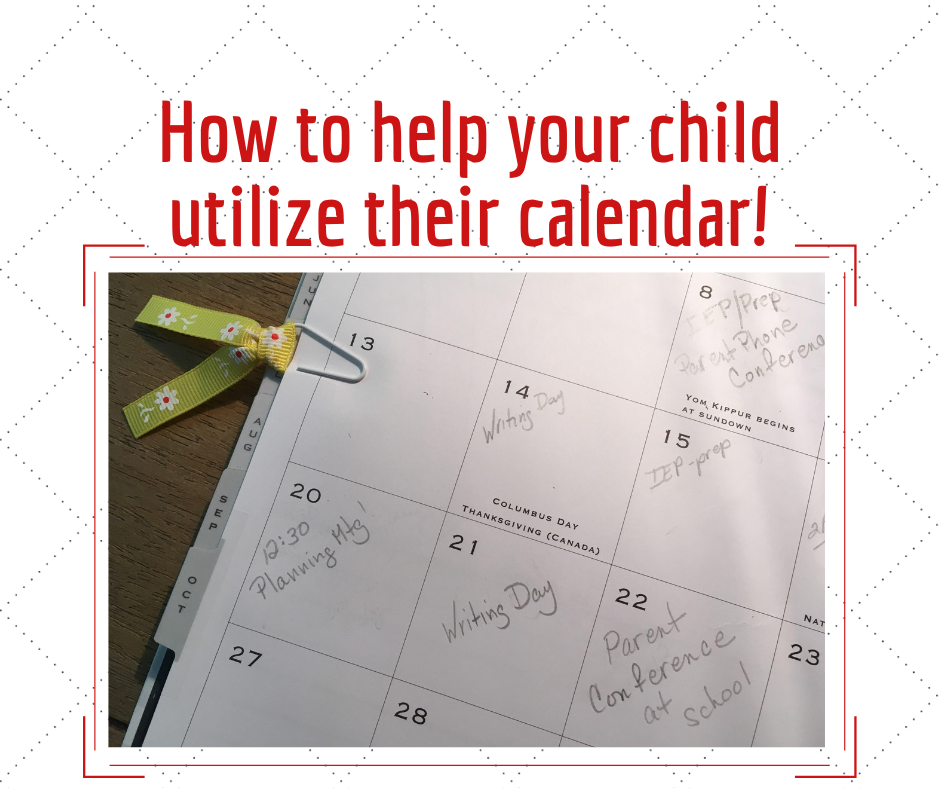
I have begun marking the week with a large paper clip attached ribbon (the visual catches my eye). Now, when I glance at my calendar I know exactly what week it is and how to set my priorities. This makes planning so much easier and more accurate. This simple act started me thinking about the children with ADD/ADHD. The leap-frogging ADD brain in action!

Children and adults with ADD/ADHD work best when what they need to do is interesting to them, urgent and time bound. Sometimes the interest alone is not enough to get us down to work, produce something and complete it.

As an educator and advocate, I have often been involved in IEP/504 conversations about the use of a calendar to support students. Making sure the student is using a calendar, entering the due dates for projects, setting up partial due dates, color-coding by subject, even having the calendar signed by the parent and the teacher are all great ideas, yet they rarely have a huge Impact.

Putting an activity or obligation on the calendar without a visual starting date does not create the sense of time and urgency that drives the ADD/ADHD brain. The passage of time is something we do not pay attention to.

The one thing we never discussed is marking on the calendar the CURRENT WEEK and DAY the assignment is given in relation to the DUE DATE/COMPLETION DATE which is different from the TURN IN DATE.

Notice I am using the phrase TURN IN DATE as the final date to be noted on the calendar I have made this change for two reasons. 1)The assignment needs to be COMPLETED prior to the TURN IN DATE. 2) Turning in the assignment is the Final Step in the process. 

This is a deliberate change on my part because of the overwhelming need for children to TURN IN their work. I will write more about this loss of executive functioning skills at a future time. For now, this is about setting up and having your child utilize their calendar.

4 Step Visual Planning Calendar:

1. START DATE is the day the assignment is given
2. Partial Project completion dates (on their IEP/504 or created by you at home)
3. DUE DATE/COMPLETION DATE for the day the work needs to be finished
4. TURN IN DATE (should be seen over and over again) is the day the work is to be handed in!

These small visual touchpoints serve to support the development of needed executive functioning skills while continuing to reinforce the time/urgency aspect of getting things done that is needed by your child.

If at all possible, make 2 versions of the calendar. One for your student to have with them and another large one that is easily referred to at home. It should be in a central place where a quick visual scan, along with changes, can be done easily.

Sometimes it is the smallest change that can have the biggest impact.

Do you have a question or need? Reach out!  I would love to answer your questions and in doing so, I often get my best ideas on how to help so many others. Share your concern today and let’s get to problem solving!

2 Comments

Response to Intervention and Multi Tiered System of Support vs. IEP

10/14/2019

1 Comment

 
Picture


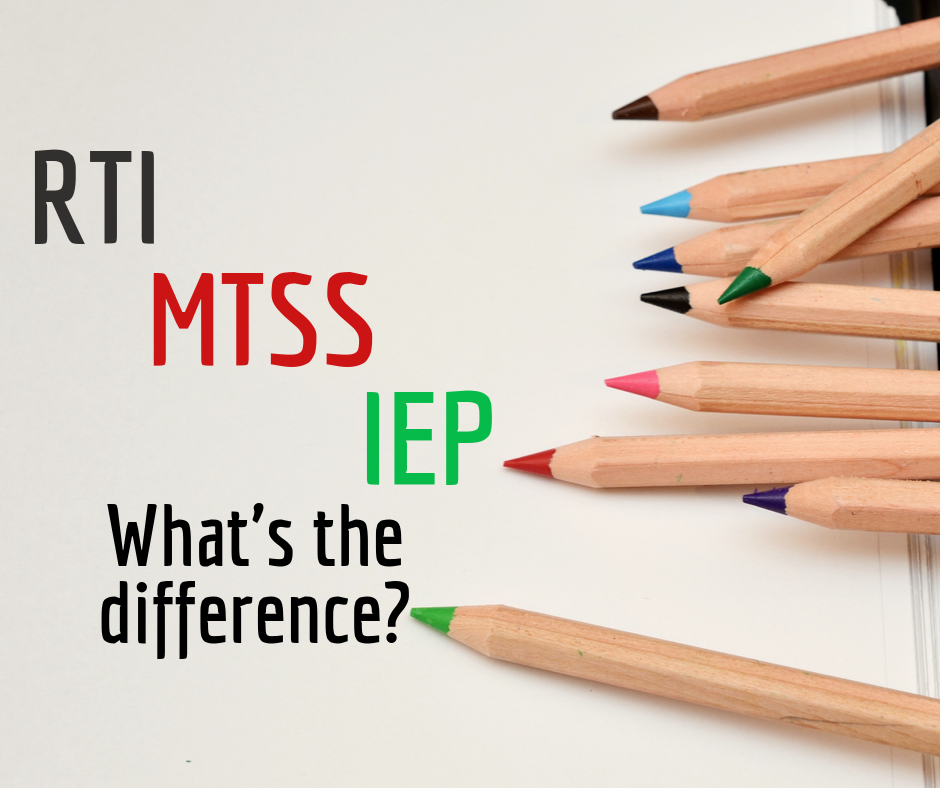
​A word about Response to Intervention (RTI) or the Multi Tiered System of Support (MTSS) and how it differs from an Individualized Education Plan (IEP).


Many parents reach out to me concerned that the school does not want to evaluate their child for a learning disability but instead wants to provide support through RTI or MTSS. They feel that the school does not take what is happening, or not happening, for their child seriously enough. Often times the parents express it as the school does not want to help. 

RTI and MTSS are first line support systems that schools are mandated to implement when a child is not performing up to grade level standards. The tiered system describes what those interventions look like and how they are to be implemented and monitored. Each tier is time bound and growth is to be monitored for the student's success. 

In a 3 Tier system, Tier 1 is the general education classroom curriculum. Tier 2 are those small groups of students that work, in the classroom directly with the teacher. (Think of the horseshoe table with a teacher sitting with the students.) Tier 3 is more intensive, often with non-classroom materials, a different instructor and weekly assessment. Tier 3 is where growth has to be demonstrated, or not, before a child is referred for an evaluation. 

The belief driving RTI/MTSS is that with focused instruction, in the area that is missing, a child can catch their peers. This is a growth model at the core. Something instructional has been missed. If we can determine what that is and work on it repeatedly the student will make progress to the extent that they will be able to learn as originally hoped. 

The RTI/MTSS construct says instruction, when improved, will eliminate the need for something beyond general education. 

An IEP is a vital document to support learning for students that have an identified disability. The IEP may require a unique way of teaching, instruction may take place in a different setting/classroom/school, a longer learning time that is reflected in personalized learning goals, etc. 

The IEP construct says this is not a gap in instruction but rather a need for something beyond general education to support learning. The goal of the IEP is to meet a student’s needs with specialized learning and supports for as long as necessary to attain success. 

What is imperative is that your child gets what they need, when they need it, to make their education appropriate and meaningful for them to be all they can be now and in the future.

​
1 Comment

An Active Child: Do's and Dont's

10/7/2019

0 Comments

 
Picture

Do you have an ‘active’ student at home or in your classroom? Here are some easy tips for helping them to do their best at school and at home. 

(Some of these tips do not need an IEP, some do.)

1. Give them multiple workspaces. Active children benefit from the ability to move around. Some children like to stand while they work. My son actually stood at the window sill. Others like to cocoon under their desks or in a corner. The point is to let them find, and even change, their place where they work.  The outcome is getting the work done. 

2. Limit the amount of busywork they have to do. If a child has demonstrated that they know the material eliminate the extra practice work once the concept has been mastered. 

3. Keep them moving with a purpose! Errands and chores are the active child’s best friends. Often times they lack self-esteem and social awareness so being helpful is one of the best ways to alleviate those issues. 

4. Have a group of ‘high-fliers’ in your classroom? Let them do a class newspaper, grade level newspaper, put up/take down bulletin boards or read to younger children.

5. Never use recess as a tool for modifying behavior. Recess is a necessary part of the day for the active child. 

6. Never assign silent lunch. It is demeaning, demoralizing and negative. 

7. Give them time after school to move around before starting homework. Utilize the above tips about workspace and movement. Keep elementary children near you but try not to sit with them as they do their work. 

8. Incorporate movement and rhythm into learning. Whenever possible, have your child stand up and move while learning something new.

​
0 Comments

    Author

    Kathi is a retired educator who is passionate about helping children succeed in school and in life.

    Archives

    February 2021
    January 2021
    December 2020
    November 2020
    October 2020
    September 2020
    August 2020
    July 2020
    June 2020
    May 2020
    March 2020
    February 2020
    January 2020
    December 2019
    November 2019
    October 2019
    September 2019
    August 2019

    Categories

    All

    RSS Feed

Proudly powered by Weebly
Photos from US Department of Education, ironmancurling
  • Welcome
  • Who is KSW
  • What we do
  • Contact
  • Blog
  • Parent Resources